active seeing
by Matthias •Seeing is something we usually regard as an inward directed process. With that I mean that as you are perceiving objects outside of you, something happens inside of you. Observing the outer world comes with changes in the inner world. This outside-to-inside direction can be turned around.
When I was a kid I enjoyed playing with Lego Technics quite a lot. During that time I got a tiny insight that I still remember till this day. My set of building blocks contained pneumatic cylinders, which resembles the big hydraulic cylinders you see on big machines like excavators. Those little Lego cylinders work with air. Pushing air in and out the cylinder expands or contracts the cylinder. This way I could control the movement of the cylinder by controlling the air flow.
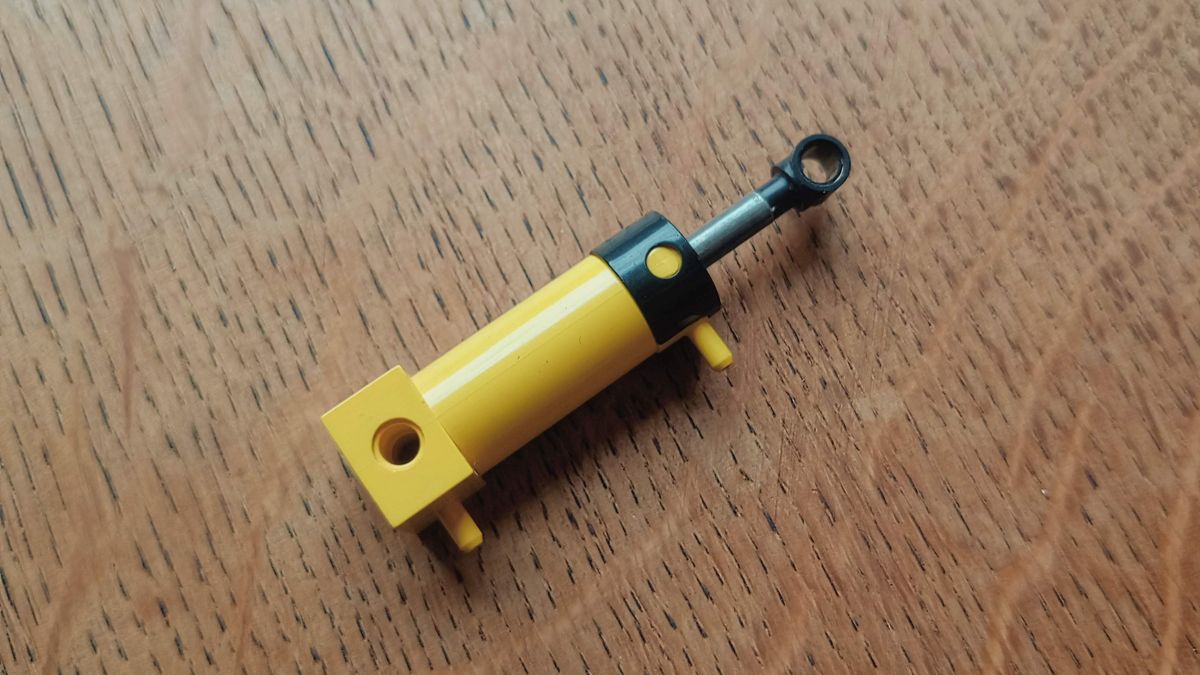
But, as I played around, I noticed the opposite was also true, if I pushed down on the cylinder, air would come out, if I would draw the cylinder back out, the air would be sucked into the cylinder. There is a strong correlation between the moving of the cylinder and the moving of the air. The air and mechanical movement of the piston have a strong coupling, if you manipulate one, it has an effect on the other.
John is mostly grumpy. Maria is an adventurer. We say we know the people in our lives. What we mean by "knowing", is that we carry a mental model of them in our head, one that more or less predicts how they will behave. Through experience we build these neurological circuits of them in our brain. That's how we come to remember how they are, and how we "know" that John is mostly grumpy. Our experiences of them are thus shaping parts of our brain that reflect those experiences.
Our neurology contains a map of our past experiences. Someone who was abused probably has a brain shaped differently from someone who had a nurturing life. Our outer world literally influences the shape of our internal world / neurology. Just like the movement of the Lego cylinder being strongly correlated to the air flow. So it seems the outside world strongly correlates to one's inside world. But is this also a bidirectional coupling just like the Lego pneumatic cylinder? Can we also turn this the other way around?
To me, active seeing is an experiment trying to turn it around. Instead of seeing something happening in the world, and as a result have an internal change, I start to see/believe/imagine (and thus changing my neurology) so something will happen/change in my external world. I am trusting/believing that the coupling between inner and outer world must hold. So the idea is that if I make changes in how I see the world, my outer world has to follow.
Of course, one can easily say that it's a fantasy, kid stuff, to see/imagine something that is not there, that it's delusional, this is not how reality works. But why do we tend to have this fantasy/imagination capacities as a child? And does it then have no purpose at all? Would it just be another skill that we reject from our childhood? Many skills we leave behind, often judged as childish. I believe we should not abandon them, but integrate them instead for they make up a sane, rich and healthier life.
To some degree we are still practicing these imagining skills. Think of the athlete who imagines finishing a race faster than before. Or think of how one reminds one self "I cannot sing"; most likely the singing will not happen. In a way these are examples of internal practice, shaping our neurology, which our reality reflects.
Might this mind-to-reality-coupling also come to play when it involves others? When someone is caring about you and knows what you have been through, it might be easier for you to feel safe or recognised by that person. Or have you ever found it difficult doing something, let's say in a crowd, when everyone thinks you probably can't do it. There might be another situation where you found a task easy when everyone is cheering you on? The activated neurology of the others, the beliefs/perception of those around you, is nudging their outside world in that direction, in this case that outside world includes you. The neurological map others activate is influencing your behaviour and what you can and can not do easily, statistically speaking.
It's interesting to think about this neurological map in your head, with all it's convictions and beliefs, how this influences another person. In a way this helps holding a person in a particular state. This can be a serving/good thing, as the map in your head stabilises the state of the other. But it can also not be, if your mental map, how you see this person, is helping to keep a person in a state that you or that person might actually not serve or desire.
In unpleasant situations we often tend to direct our willpower to the outside world, try to change the person, to speak to them, to physically take distance, etc. But sometimes that does not work, or it is even counter productive. We tend to focus only on changing the external world, because we do not see this bidirectional coupling. Changing the map-in-our-own-head of this person instead, is not something we think about.
Something happens when former grumpy John, turns up unexpectedly as bright and delightful John. The coupling concept suggest that if the external world changes the inner must too. Your mental model of John will change, because you just experienced that John can also be bright and delightful. The coupling between outside world and inside works insinuates that you could also start picturing John as bright and delightful even when your outside world, your experience of John, clearly has not shown that yet.
So when allowing oneself to use fantasy again, one can start to see in an active way, seeing things, imagining things, that are not yet shown in the outside world. To see things that one wants to see in the world, even if they are not there yet, and to let the outside world follow. Then you are seeing in an active way, then you have turned it around. You are actively seeing something into reality, instead of seeing something from reality into you.
One can stop seeing the limitations in others, that already helps. But one can go further than stop projecting a lesser belief, or repeating the lesser stories we think about others.
Maybe before you go to sleep, when the day has settled, try to see a person the way you would want them to be, actively, in your head. Maybe this time, in your fantasy, for example, this particular person does clean up after cooking, or does takes care of himself. You will notice tension/resistance. Your brain believes this person does not acts in this way, or is not like this or like that. This shows how much resistance there is to seeing reality the way we would choose to see it. It shows you how much you are participating, through this principle of coupling, in holding that person in an undesired state. We can take our responsibility to another level as your perception of the other, the world, matters. It takes effort to start pushing air back into the Lego cylinder whilst the cylinder head is not yet moving. So does it also take effort to reshape your own beliefs/perception/state of something that in reality has not yet changed. As you will notice, as soon you start to become "delusional", as soon you picture a person in a way that is not how you currently see/experience this person, you will notice a complaint. The brain and body show up with a neurological, chemical and emotional resistance. We are not used to move in the opposite direction of the mind-reality-coupling.
I have practiced before, at night, in bed, before going to sleep, seeing another that hurt me in a different light. To love them, to forgive them, to thank them, can be a process with a lot of friction. Because in the moment I do not love them and do not want to thank them. But the bigger picture, the more serving and grander vision is that I do. Doing this practice over and over again, I changed my mental map about this person. So the next time we met, my inner practice, had a positive effect.
Maybe we do not solely change on our own. We help each other by actively seeing one other in a serving way, even though our reality is not showing that (yet).
It is quiet, behind the scenes internal work. You will not get rewarded/praised for it in the common sense. But the reward is high. Actively seeing something into another, into the world, holding that vision, gently, whilst knowing it is not here yet, knowing it will become, somehow, eventually.